
The Fynbos Seeds That Wait for Fire
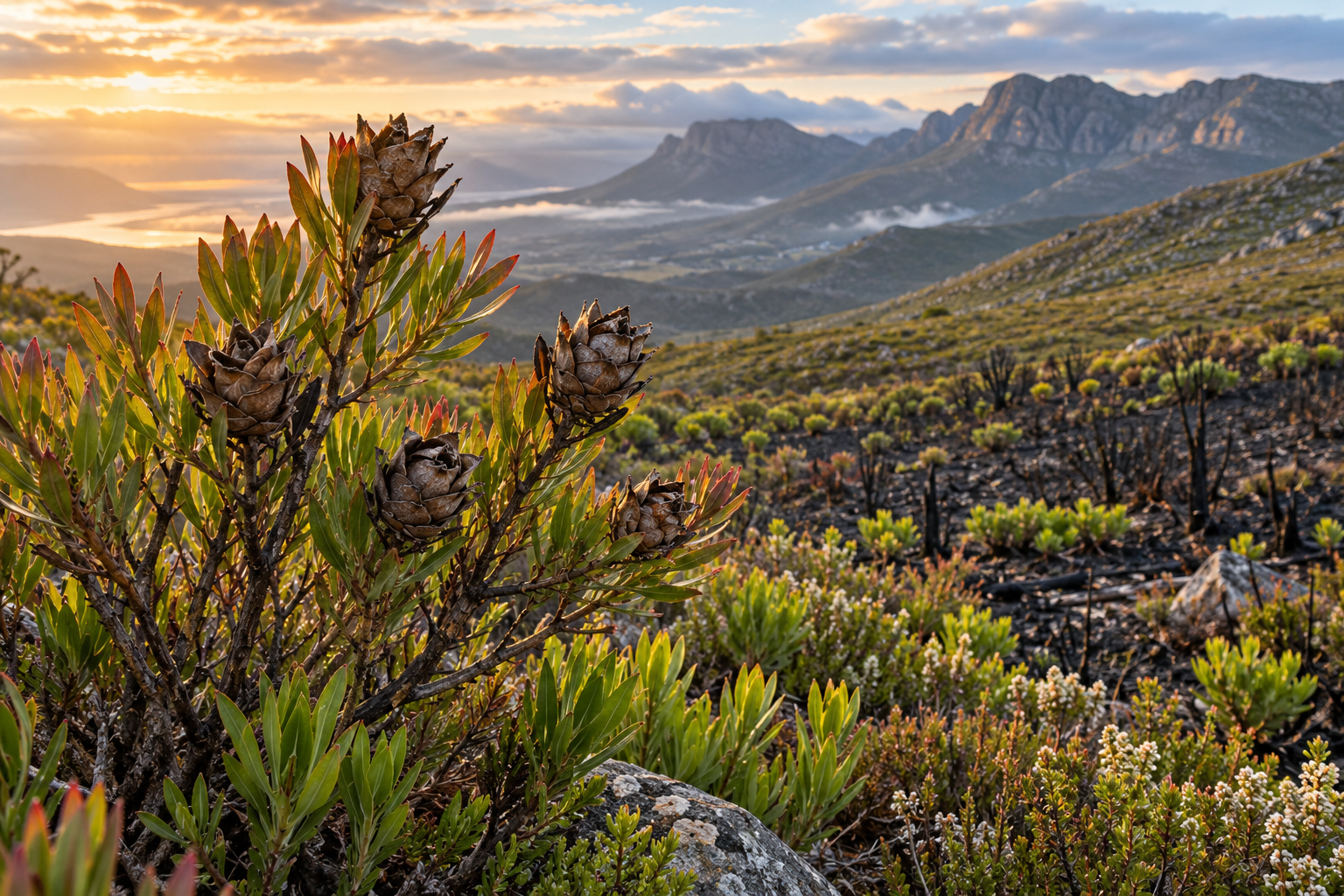
That is one of the remarkable things about fynbos: renewal is not a single trick shared by every plant. South African researchers have found that even closely related species can respond to fire in very different ways.
A SEED BANK IN THE BRANCHES
Some cone-bearing plants in the Proteaceae family practise a strategy known as serotiny. Instead of releasing every seed as soon as it matures, they retain seeds in woody structures on the plant. The cones hold them there, in some cases protecting them from being eaten, until conditions favour their release.
When fire passes through the vegetation, heat and drying can help those cones open. Seeds are released into a landscape where the surrounding plants have been cleared back. They can then settle among ash and plant litter, ready to respond to the next stage of the cycle: moisture.
This is not a dramatic instant transformation. A fire does not simply switch a hillside from black to flower-covered. It is one event in a longer sequence, and the seeds still need suitable conditions to germinate and establish.
NOT EVERY SEED WAITS IN A CONE
Other fynbos plants release their seeds earlier. Those seeds may lie in the soil, where some can persist until a fire changes the conditions around them. Smoke contains chemical cues that can encourage germination in certain species; heat can also play a role.
A 2021 study examined the effects of heat and smoke on seeds from 40 species of Leucadendron, a genus found in the fynbos. The researchers identified species whose germination was fire-dependent, fire-enhanced or fire-independent. In other words, some needed a fire-related cue, some germinated more readily with one, and others did not depend on those direct cues.
The location of a seed store offered a useful clue: seeds held in the soil were more likely to respond to fire cues than seeds retained in the plant’s canopy. But nature kept an exception in reserve. The researchers highlighted Leucadendron linifolium, a cone-bearing species whose seeds require smoke to germinate.
That detail challenges the simple picture of a cone opening and a seed immediately beginning to grow. The same genus contains several strategies, and the answer depends on the species.
FIRE IS PART OF THE STORY
Fynbos plants have evolved alongside fire, but that does not mean every fire is helpful or that every patch responds in the same way. The timing and intensity of a burn matter, as do the needs of the plants growing there.
Research on fynbos seed strategies points to the importance of understanding each species when restoring or conserving habitat. A smoke treatment that helps one plant may not be the right cue for another. Even the striking exception of L. linifolium shows why a broad rule can miss what is happening at ground level.
The challenge is made greater by pressures such as invasive plants, urban expansion and more frequent, hotter fires. Learning how native species reproduce can help conservationists make better-informed decisions about restoration in the Cape.
A LANDSCAPE WITH A LONG MEMORY
Fynbos is home to South Africa’s national flower, the king protea, as well as the silver tree and rooibos. It is part of the Cape Floral Kingdom, a region valued for its extraordinary plant diversity. Mountain catchments in the region also help supply water to Cape Town.
The next time a fire-scarred slope begins to show green again, the first signs of recovery may be easy to overlook. A seed may have travelled from a cone; another may have waited beneath the soil. Some may be responding to smoke, while others simply need the right season and enough rain.
The fynbos does not begin again in just one way. Its seeds carry a quiet record of different histories, each shaped by the place and conditions in which that plant survives.
In this landscape, even a seed’s waiting can be part of the way forward.
What's your reaction?
About Angela Jacobs

Angela Jacobs writes knowledge articles, fun facts and features on fascinating topics for Trustoria. Born in Klerksdorp and based in Cape Town, she combines careful research with an engaging, accessible style, exploring everything from everyday curiosities to surprising discoveries. Her work invites readers to learn something new and discover the interesting stories behind familiar things.
READ FULL BIO →