
Why Is the Ocean Salty When Rivers Are Fresh?
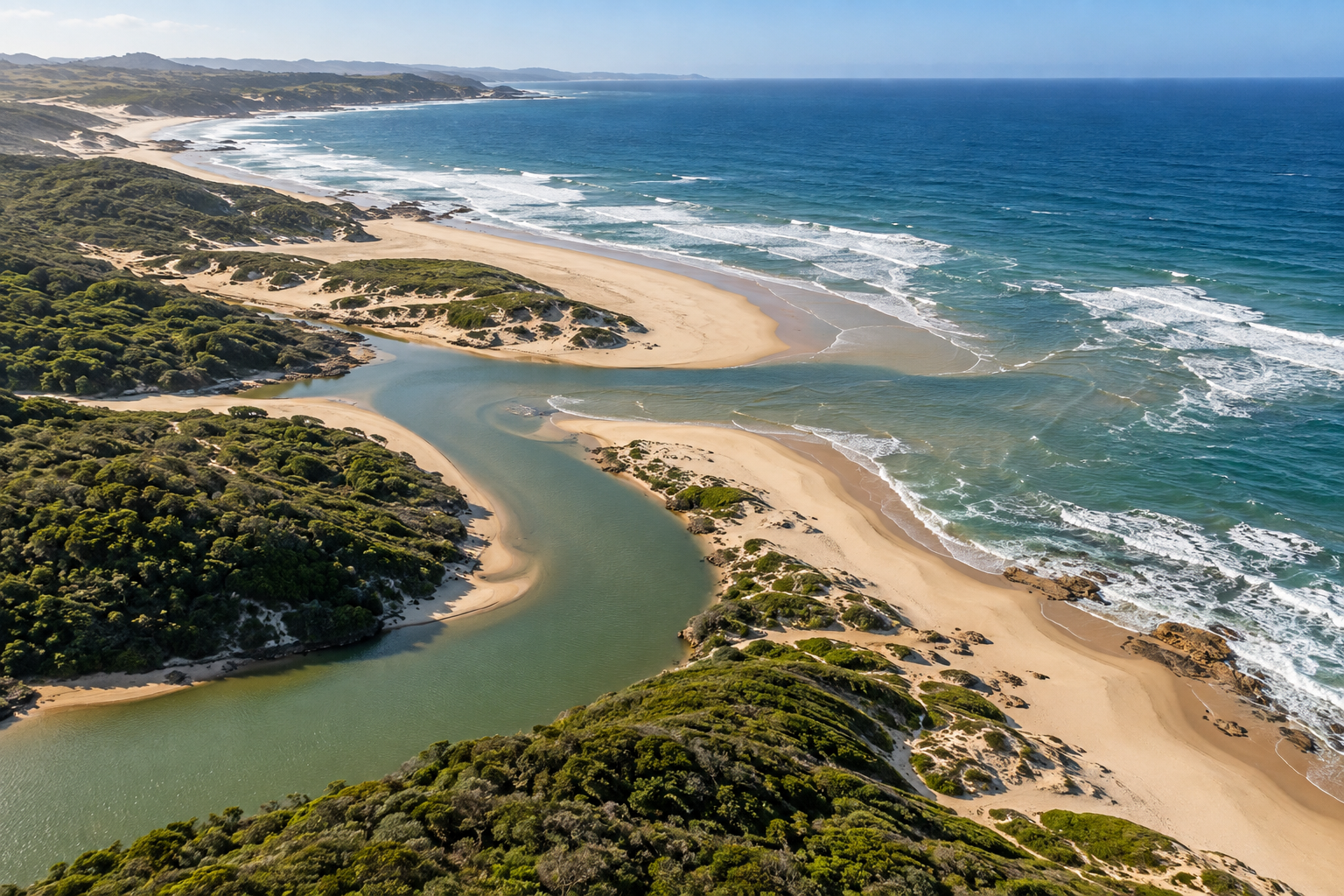
The answer begins far from the beach, with rain falling on land.
A JOURNEY THAT STARTS WITH ROCKS
Rainwater absorbs carbon dioxide, making it naturally slightly acidic. As it moves across and through the ground, it helps break down rocks and dissolve some of their minerals.
The dissolved material travels into streams and rivers, eventually reaching the ocean.
So freshwater is not completely free of dissolved salts. Rivers carry them too, usually in concentrations far lower than those found in seawater.
A river can look perfectly clear while transporting material too small to see.
THE WATER LEAVES, BUT THE SALT REMAINS
Evaporation is an important part of the explanation.
As water evaporates from the ocean’s surface, it enters the atmosphere as water vapour. The dissolved salts remain behind.
That water can later form clouds and return as rain, continuing its journey through the water cycle.
Imagine leaving a shallow dish of salty water to dry. As the water disappears, a salty residue remains. The ocean is vastly more complex, but the basic separation follows the same principle.
HOW MUCH SALT IS IN SEAWATER?
Average seawater contains roughly 35 grams of dissolved salts per kilogram—about 3.5% of its mass.
Sodium and chloride, the components of ordinary table salt, account for most of that dissolved material. Seawater also contains substances such as magnesium and sulfate.
The concentration is not identical everywhere. Evaporation tends to increase salinity, while rainfall and incoming freshwater can dilute it.
THE SEAFLOOR CONTRIBUTES TOO
Land is not the only source of dissolved minerals.
Seawater can enter cracks in the ocean floor, become heated and react with surrounding rock before returning through hydrothermal vents. These exchanges change the water’s chemistry, adding some substances and removing others.
Underwater volcanic activity also contributes minerals.
DOES THE OCEAN KEEP GETTING SALTIER?
Not simply or endlessly. Natural processes also remove dissolved material from seawater, including its incorporation into organisms and sediments.
NOAA explains that inputs and removals broadly balance over long periods. The ocean is a changing system with both arrivals and departures.
A BIG STORY IN A SINGLE WAVE
Standing on a South African beach, it is easy to think of the sea and the land as separate worlds.
Yet the water washing over your feet carries evidence of their connection: rainfall, weathered rock, flowing rivers and activity beneath the seabed.
That familiar salty splash is part of a much longer planetary story—one still unfolding with every rainfall and every tide.
What's your reaction?
About Zanele Mthembu

Zanele Mthembu covers South African community news for Trustoria, focusing on municipal developments, social justice and local culture. Based in Durban and rooted in her Zulu heritage, she brings clarity and compassion to stories that affect everyday lives, combining a commitment to accountability with a passion for highlighting community achievements, resilience and positive change.
READ FULL BIO →