
The Dance That Gives Directions: How Honeybees Share the Way to Food
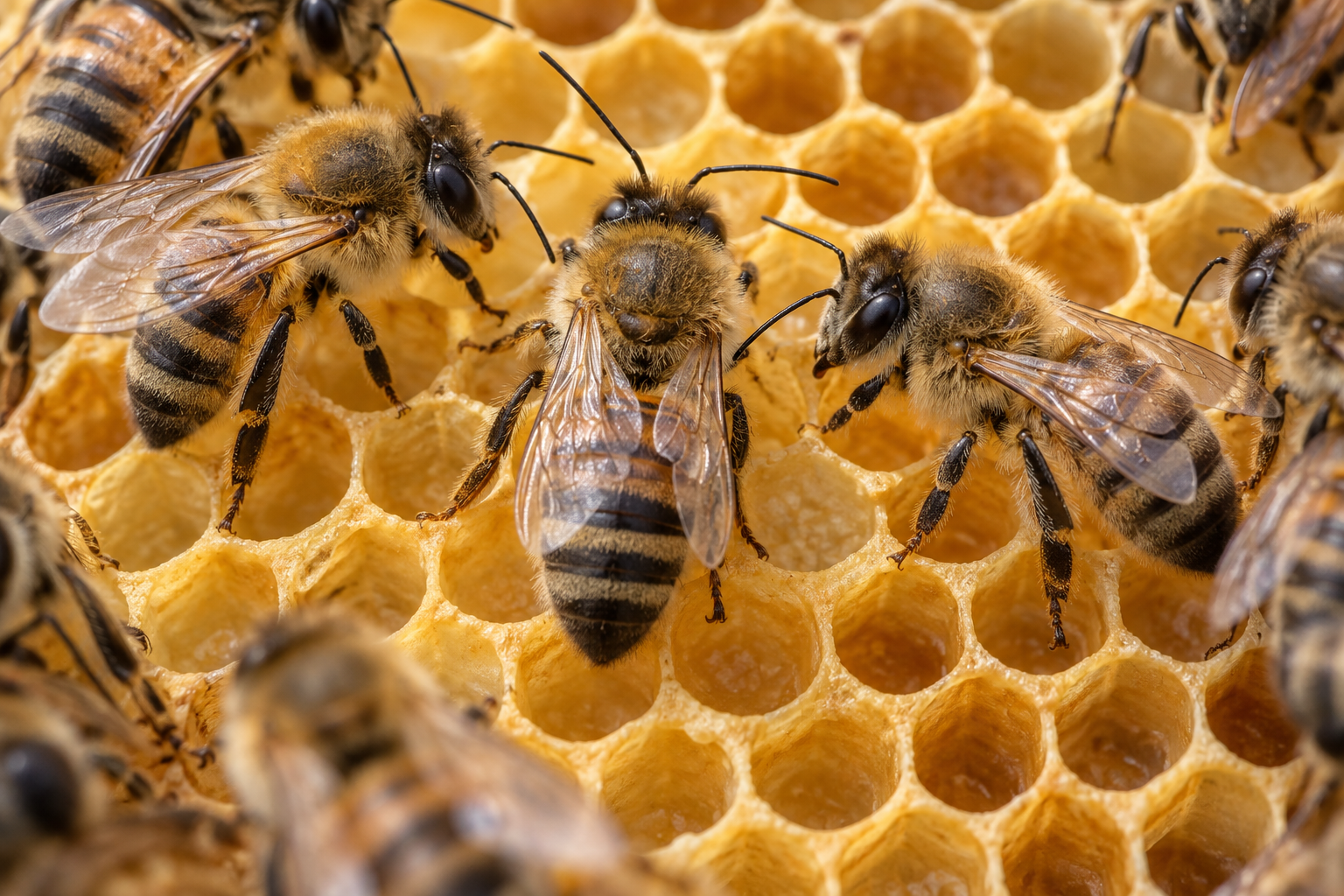
It is called the waggle dance, and understanding it changes the way you look at an insect you might otherwise barely notice.
A MESSAGE WRITTEN IN MOVEMENT
During the dance, a honeybee moves through a roughly figure-eight pattern. The central section, where she moves forward while shaking her body, is known as the waggle run.
This movement carries information about the direction and distance of a resource.
On the vertical honeycomb, the angle of the waggle run relative to straight up represents the direction of the food relative to the Sun.
A run pointing straight upwards indicates a flight towards the Sun’s position on the horizon. A run angled to one side communicates a corresponding angle away from that direction.
The duration of the waggle run provides information about distance: a longer run generally signals a longer journey.
Imagine giving someone directions without speaking, pointing down a road or drawing a map. A honeybee accomplishes something comparable through the orientation and timing of her movements.
EVEN BEES BENEFIT FROM EXPERIENCE
The dance becomes more fascinating when we look at how bees develop it.
A study published in Science in 2023 found that young honeybees performed more accurate dances when they had opportunities to follow experienced dancers before making their own first attempts.
Researchers created experimental colonies in which young bees lacked that early exposure. Those bees still danced, but their movements were more disordered, and their distance signals were less accurate.
Some aspects improved with experience. However, the bees that missed early learning continued to communicate distance differently throughout their lives.
The findings show that social learning helps shape this communication. The behaviour has an inherited foundation, but experience matters too.
SCIENTISTS CAN READ THE DIRECTIONS
The messages are useful beyond the hive.
Researchers at the University of Sussex have used observation hives and video recordings to decode dances and investigate where honeybees forage.
By studying those movements, scientists can identify areas the bees find rewarding and examine how their foraging changes across seasons.
A small movement inside a hive can therefore reveal something about the landscape outside it.
A DIFFERENT WAY TO SEE A GARDEN VISITOR
The next time a honeybee pauses on a flower, consider the possibility that her discovery may become information shared back at the colony.
That brief visit belongs to a much larger story of searching, navigating and communicating.
You do not need to open a hive to appreciate it. Simply knowing that this exchange takes place adds another layer of interest to an ordinary moment in the garden.
What's your reaction?
About Angela Jacobs

Angela Jacobs writes knowledge articles, fun facts and features on fascinating topics for Trustoria. Born in Klerksdorp and based in Cape Town, she combines careful research with an engaging, accessible style, exploring everything from everyday curiosities to surprising discoveries. Her work invites readers to learn something new and discover the interesting stories behind familiar things.
READ FULL BIO →