
Listening for Danger: South African Researchers Test AI Underground
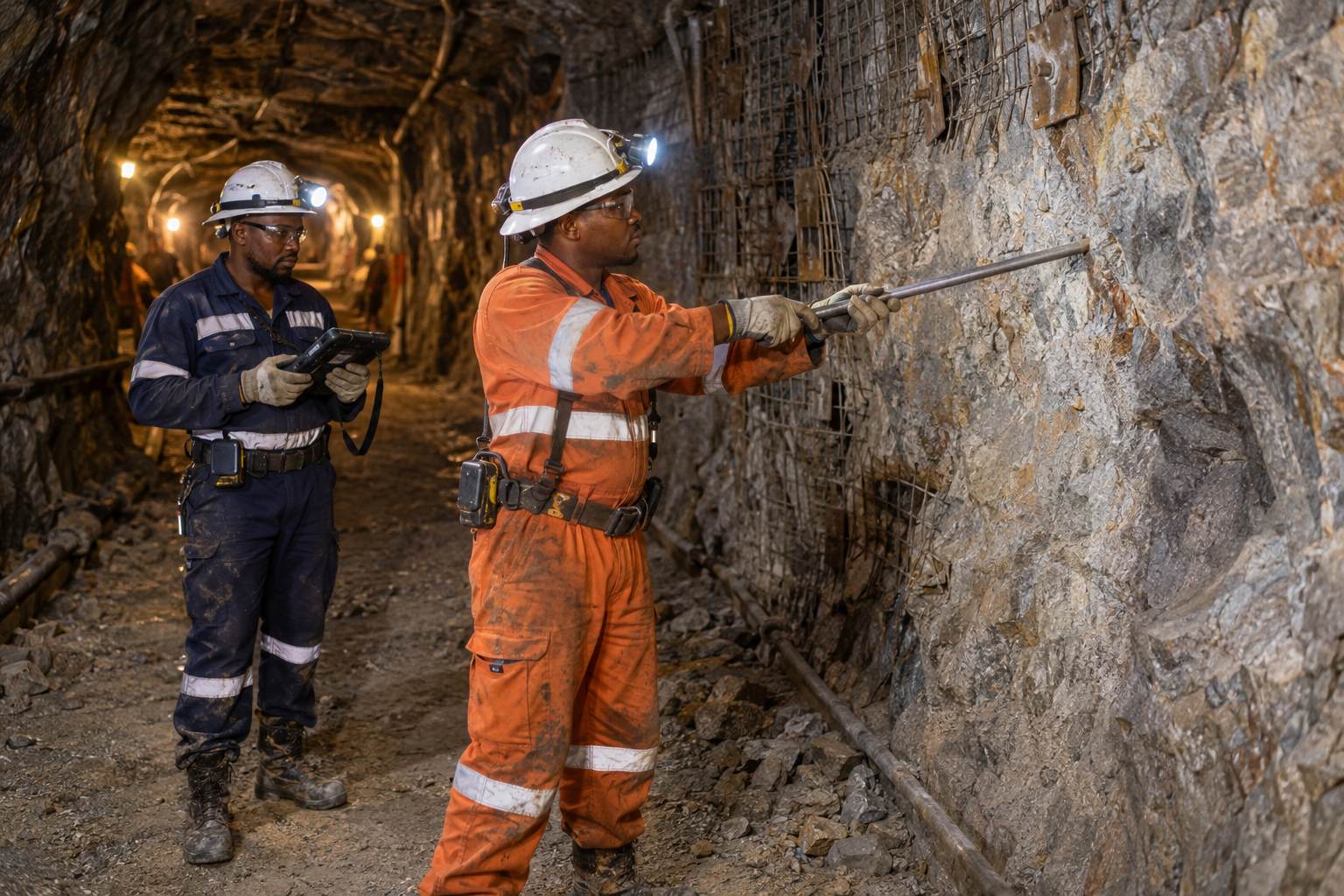
The Council for Scientific and Industrial Research (CSIR) announced on 24 August 2026 that an acoustic rock-sounding application had completed a proof-of-concept trial at Harmony Gold’s Mponeng Mine. Testing concluded on 16 July.
TURNING SOUND INTO INFORMATION
Developed with Peralex Electronics through the Mandela Mining Precinct’s Advanced Orebody Knowledge Programme, the application uses acoustic processing and machine learning to classify responses associated with solid or potentially loose rock.
Its purpose is to support trained personnel’s judgement during underground inspections.
TESTED IN WORKING CONDITIONS
According to the CSIR, the trial evaluated recording, classification, confidence scores, event logging, offline use and data export.
The result demonstrated technical feasibility. It did not establish that the application is ready for unrestricted deployment or that it has reduced mining injuries.
Further validation, model improvements and hardware refinement are planned before a controlled operational pilot.
PART OF A WIDER SOUTH AFRICAN TECHNOLOGY EFFORT
The project sits alongside other CSIR work aimed at making underground information easier to capture and use.
One example is e-PEG, a portable positioning system designed for underground environments where GPS is unavailable. The CSIR describes it as a battery-powered system that can be moved between working areas, supporting the recording of locations and observations. It remains subject to operational validation and refinement.
Another is the digital Rock Engineering Assistant, which brings collected information into a database for filtering, analysis and display on mine plans. The CSIR identifies it as a technology demonstrator, with operational testing forming part of its development path.
These are separate technologies at different stages of development. Their inclusion here provides context for the broader local effort to improve how mining information is collected and interpreted.
WHY THIS STORY MATTERS
The significance, in our assessment, is the practical direction of the research. It starts with a demanding workplace task and asks where software can provide useful additional evidence.
That is an important test for industrial AI. A convincing demonstration is a beginning; dependable performance requires repeated evaluation under the conditions in which people will actually use it.
For South Africa’s technology sector, this is a story worth following: local researchers, developers and industry specialists working together on a problem with direct relevance to the country’s mines.
What's your reaction?
About Thabo Mokoena

Thabo Mokoena covers global technology news for Trustoria, bringing a South African perspective to artificial intelligence, cybersecurity, digital innovation and emerging platforms. Based in Pretoria, he makes complex developments accessible through clear, balanced reporting that explores how technology affects everyday life, business and opportunity.
READ FULL BIO →