
Why Does the Moon Look So Big Near the Horizon?
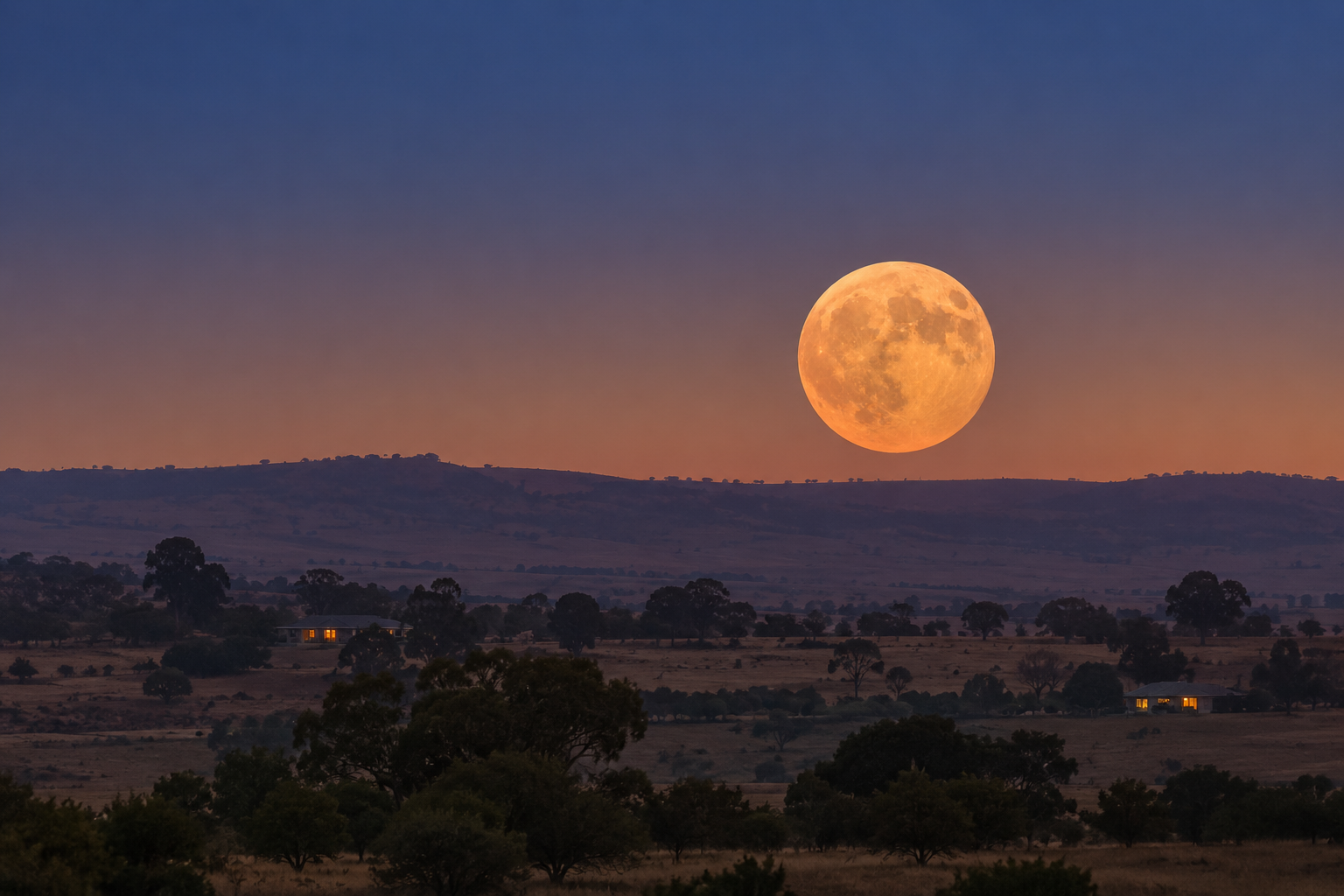
This familiar experience is called the Moon illusion. And while we can measure what is happening, explaining exactly why we perceive it remains surprisingly difficult.
YOUR BRAIN IS PART OF THE PICTURE
According to NASA, the striking increase in perceived size near the horizon is an illusion. The Moon does not suddenly grow as it rises, and the atmosphere is not acting as a magnifying glass that makes it enormous.
Instead, the effect involves how our brains interpret what our eyes see.
One proposed explanation centres on our expectations about distance. Familiar objects such as cars, buildings and aircraft appear smaller as they recede towards the horizon. The Moon does not behave in quite the way those everyday experiences lead us to expect.
Our perception may respond by making it seem larger.
That is a hypothesis, however, rather than a complete explanation. NASA notes that scientists have yet to reach agreement on precisely what causes the effect.
TRY A SIMPLE CAMERA EXPERIMENT
You can investigate the illusion yourself on a clear evening around the full Moon.
Photograph the Moon when it is low above the horizon. Later that same night, photograph it again when it is higher in the sky.
Use the same camera, lens and zoom setting for both photographs. Compare the original images at the same scale, without resizing or cropping one differently.
Measure the Moon’s width from left to right in each image. It should be almost identical, allowing for small geometric changes as Earth rotates.
The difference between that measurement and your first impression is what makes the experiment interesting. Something can look convincingly larger without taking up more space in the photograph.
BUT THAT ORANGE COLOUR IS REAL
There is another feature of a rising Moon that has a different explanation: its warm yellow or orange appearance.
Near the horizon, moonlight travels through more of Earth’s atmosphere before reaching you. More of the shorter, bluer wavelengths are scattered out of the direct light, leaving a warmer-looking Moon.
Atmospheric refraction can also make the low Moon appear slightly flattened. These are physical effects on the light reaching your eyes, distinct from the illusion of dramatically increased size.
A MYSTERY YOU CAN WATCH FROM HOME
You do not need an observatory to encounter a scientific puzzle. Sometimes, you only need a clear view past the garden wall.
The next time a rising Moon catches your attention, take a moment to enjoy it—and perhaps take a photograph for comparison.
There is something rather wonderful about a sight so familiar still giving us questions to ask.
What's your reaction?
About Angela Jacobs

Angela Jacobs writes knowledge articles, fun facts and features on fascinating topics for Trustoria. Born in Klerksdorp and based in Cape Town, she combines careful research with an engaging, accessible style, exploring everything from everyday curiosities to surprising discoveries. Her work invites readers to learn something new and discover the interesting stories behind familiar things.
READ FULL BIO →