
The Tiny South African Beetle That Finds Its Way Using the Milky Way
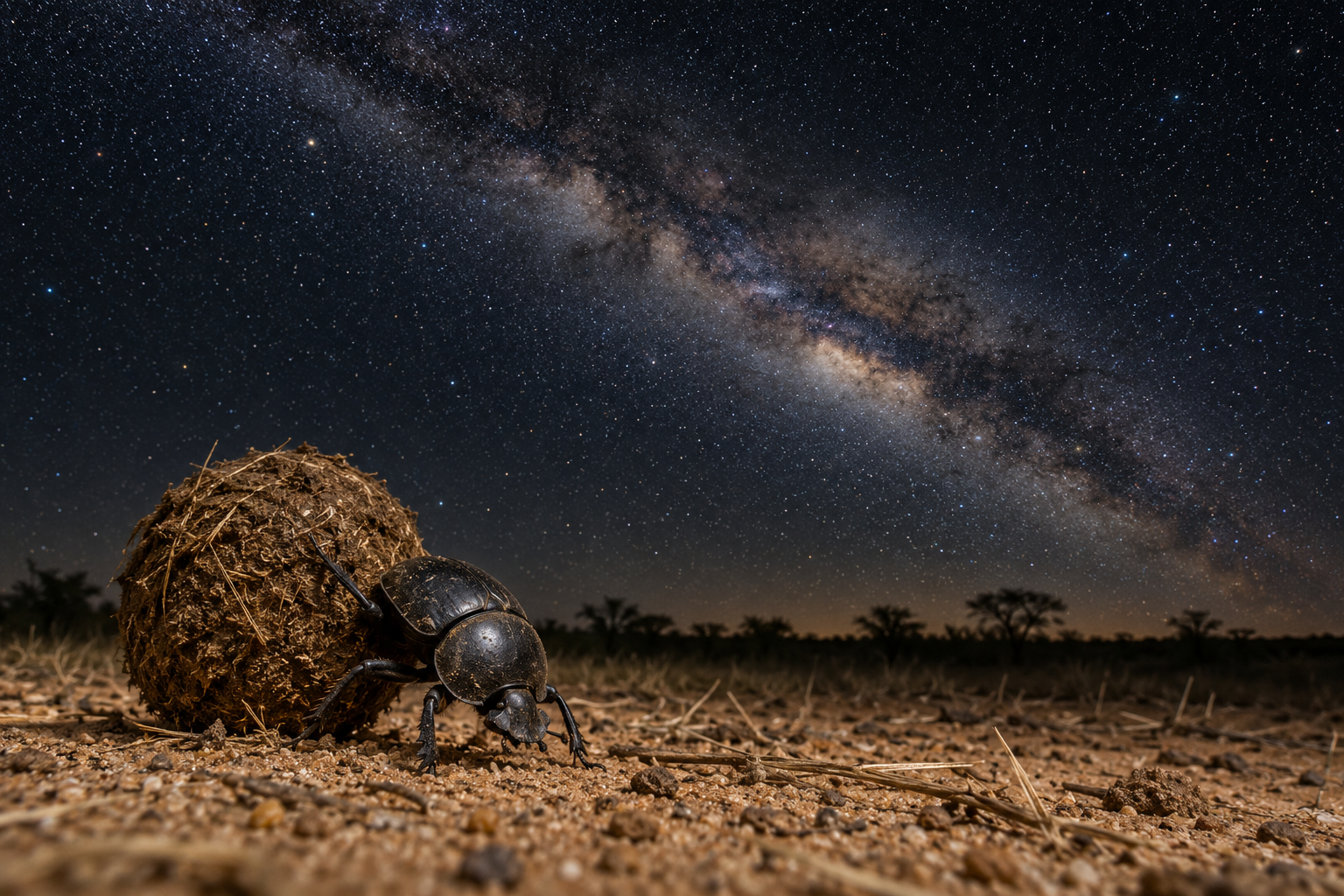
Scientists have shown that certain nocturnal dung beetles can use the Milky Way to maintain a straight course while rolling their dung balls.
The discovery, published in Current Biology in 2013, involved researchers from South Africa and Sweden. It revealed an extraordinary connection between an insect’s everyday survival and the galaxy above it.
WHY A STRAIGHT LINE MATTERS
For a ball-rolling dung beetle, a fresh dung pile is a busy and competitive place.
Once it has shaped a ball, moving away efficiently helps it avoid other beetles that might steal its prize. Wandering in circles could bring it straight back into the competition it was trying to escape.
The beetle therefore needs a reliable way to hold its direction. On a clear, moonless night, the Milky Way can provide that reference.
READING THE SKY WITHOUT COUNTING STARS
The beetles are not identifying constellations as a human astronomer might.
Their small eyes cannot resolve the night sky in the same detail. Instead, they can use the broad pattern of light provided by the Milky Way.
Think of it as keeping your direction by watching a distant feature. You do not need to understand everything about that feature; you need enough visual information to notice when you have turned.
THE EXPERIMENT INSIDE A PLANETARIUM
To investigate, researchers took the beetles into the Wits Planetarium in Johannesburg, where they could control which parts of the night sky appeared overhead.
The beetles maintained their direction just as effectively beneath a projection showing only the Milky Way as they did beneath a full starry sky.
The study provided the first documented evidence of an animal using the Milky Way for orientation.
A LITTLE DANCE WITH A PURPOSE
Some ball-rolling dung beetles climb onto their dung balls and turn before setting off.
What looks like a tiny dance is an orientation behaviour. It allows them to gather information from the sky and establish their direction.
That makes an easily overlooked movement surprisingly meaningful: a small animal pausing to get its bearings before continuing its journey.
WHEN ARTIFICIAL LIGHT CHANGES THE VIEW
Later research, reported in 2021, examined how artificial lighting affects this navigation.
Experiments in central Johannesburg and rural Limpopo found that bright artificial lights could draw beetles towards them, while a washed-out sky without a clear alternative light cue could leave them disoriented.
The findings give dark skies a significance beyond the pleasure of stargazing. For animals that depend on natural light patterns, darkness helps make important information visible.
A DIFFERENT WAY TO SEE SOMETHING SMALL
A dung beetle is easy to walk past. Its work happens close to the ground, usually without much attention.
Yet understanding how it travels changes the scene entirely. The insect, the ball it pushes and the distant light overhead become parts of the same remarkable story.
The next time you look up at the Milky Way, remember: something much smaller may be finding its way beneath it.
SOURCES
Lund University — Dung Beetles Use the Milky Way for Orientation (2013 research)
Wits University — Navigating life through the eyes of a gogga
Wits University — How light pollution affects dung beetles (3 August 2021)
What's your reaction?
About Angela Jacobs

Angela Jacobs writes knowledge articles, fun facts and features on fascinating topics for Trustoria. Born in Klerksdorp and based in Cape Town, she combines careful research with an engaging, accessible style, exploring everything from everyday curiosities to surprising discoveries. Her work invites readers to learn something new and discover the interesting stories behind familiar things.
READ FULL BIO →